
© Grit Siwonia (all images in this article)
An interview by Chiara
Shamanism – a concept much discussed today, yet often vague. Especially in connection with psychedelics, it appears again and again, because for centuries mind-altering substances have been closely interwoven with shamanic rituals. But shamanism encompasses much more: it’s about healing paths that connect body, mind, and soul – and about how we can invite intuition, connection to nature, and spiritual experience back into our lives.
In this interview, Berlin shaman Katja Neumann shares her personal journey and explains what shamanism actually means, what prejudices she constantly encounters, and how one can discover this path for oneself. She talks about the role of psychedelics, her own experiences with them, and gives valuable tips on what to consider when preparing for a first psychedelic journey. She repeatedly emphasizes: healing is not quick consumption, but a process full of dedication, humility, and personal responsibility.
The Personal Path to Shamanism
If you were to describe your work or your path as a shaman with a metaphor, what would it be?
My first thought was the story of the ugly duckling becoming a swan. This is not about appearances or self-glorification, but about bringing what has always been there into fruition and into a livable form – finding my place on Earth.
What is the deeper meaning of shamanism for you?
The deep connection with Mother Earth, uniting the outer with the inner nature; the love for the vibrancy of all that is; and the lived respect for it – as well as lived multidimensionality.
How does one become a shaman and what qualities should one bring to it?
Of course, there is this inner calling, often spoken of, plus a love for nature and animals, a connection with heart energy (which means being in compassion with everything and knowing that we are love, not intellect). Added to this is the ability to dream, often coupled – as in my case – with extraordinary life events, strokes of fate, or special life experiences.
Nevertheless, behind it all is always intensive, years-long training. One doesn't just "become" a shaman – the craft must be learned. I'm really strict about this, because there's so much half-knowledge that leads skeptical laypeople to feel confirmed in their prejudices and believe that these are just empty promises that are useless. As everywhere, there are many "quacks" here too. It's incredibly difficult to recognize if someone has had good training. Since it is neither state-recognized nor prescribes norms for what one must fulfill, anyone can call themselves a shaman – a bit of a curse and a blessing at the same time.
What types of shamanism are there and how do they differ?
Every culture used to have its shamanism – we here in Europe did too – so there are probably as many types of shamanism as there are continents. Roughly speaking, the Nordic regions work a lot with trance via drumming, dancing, and singing. The South American and African regions also like to use plant medicine, as it grows there – not in the north. Explained very pragmatically.
How did you get on this path? Do you remember a particular key moment or situation?
I was always searching, I just felt wrong in this world, like I wasn't made for here. There were two key moments: a rabbi in Israel who predicted it for me when I was in my early 20s – I couldn't make much sense of it then, but it stuck with me. And two books my mother gave me almost 30 years ago: The Celestine Prophecy by James Redfield and Soul Retrieval by Sandra Ingerman. It was as if chandeliers lit up for me.
What is the most important thing shamanism has taught you about yourself?
I learned that "being normal" is also not a solution – at least not for me – and that's great. I enjoy being a so-called fringe group, a black sheep. Also, that emotional intelligence is much more important than intellectual intelligence. That sensitivity is not a flaw, but a gift. And indeed, I learned to love myself.
Shamanism is often described as a bridge between the visible and invisible worlds. How would you define it, and what distinguishes this path for you from other spiritual or therapeutic approaches?
It is – alongside Asian healing methods – the oldest we have. Thus, one can say that many newer healing methods such as hypnosis or guided meditations or guided imagery have developed from shamanic healing techniques.
Since I am a free spirit, I like that it is not based on dogmas. At the same time, one is "only" an intermediary – any "New Age ego" is out of place. It's not me who determines what needs to be done, but always the spirits who do the actual healing work in teamwork with the soul of the person. So it has a lot to do with humility and devotion. I don't want to deny this to other healing methods – everything has its justification – but it doesn't follow pages of concepts. It is simple, concise, and clear. Unless, of course, one makes a big fuss out of it.
How can you tell if someone is trustworthy?
First and foremost, feelings and intuition can answer this question – I immediately know if someone is a good fit for me or not, and that also answers the question of trustworthiness. If you're unsure, of course, a look at their vita and training helps. Shamans should also have solid training – otherwise, it can be really dangerous. I have often helped people who felt worse after amateur shamanic treatment because they were more burdened or blocked afterward than before.
This training should have lasted longer than a Saturday afternoon workshop. Indigenous shamans often learn for 10-15 years. Then the question is: How long has the person been working with it? Of course, there's a huge difference between someone who has been working with it for three months or for 30 years – and, most importantly, whether they have life experience. Someone who offers ten different healing methods would make me suspicious – they cannot master everything equally well. Quality restaurants also don't offer 50 different dishes from five countries. Quality has something to do with focus.
And a responsible person NEVER makes healing promises – that is unprofessional.
What misunderstandings or prejudices about shamanism do you encounter repeatedly in everyday life, and how would you like to clarify them?
Things that stubbornly persist, briefly corrected:
- Shamanism is not a "primitive religion." With the help of the spiritual world, order is established between body, mind, and soul – it is thus healing work, one of the oldest and most proven we have.
- It is not a miracle cure – one's own willingness to leave the comfort zone and take responsibility for one's own life applies here too.
- The future is neither predicted, nor are decisions made for you. Shamanic work serves healing, meaning that the original shamans often don't even tell you exactly what they did. Our Western ego, however, wants to know and analyze everything. But it is not necessary to understand everything – on the contrary, it's about trust.
- Manipulation is NOT healing work. Sometimes people come to me wanting me to make someone else do or not do something. No! Even if it would serve their well-being – the person must want it themselves and commission it.
Honestly, I have little urge to educate, proselytize, or convince – I don't need to prove anything. If someone asks me, I'm always happy to share. Before a first session, I tell them what definitely will NOT happen. So, I like to disillusion.
In what moments or phases of life do people seek your support?
Everything is represented: existential crises, disorientation, relationship issues, severe physical or chronic illnesses, sexual and/or emotional abuse, and other mistreatment. Some simply come to do something good for themselves, or every few months to ground themselves and recharge. It's like an update on the soul's hard drive. I also work with traumatized animals, as well as with couples, friends, or parents with children.
I do not treat schizophrenia or other serious psychological disorders. I have too little knowledge of these, and such people can experience episodes due to drumming that I cannot manage.
How can one imagine a shamanic treatment with you – what rituals or practices do you use to guide people on their path?
My tool is the shamanic trance drumming journey. Through monotonous drumming with the shamanic drum, the mind calms down, the brain hemispheres synchronize, and the so-called alpha state emerges – like just before falling asleep. It's a light trance in which images can arise. Shamanically, this state is used to get in touch with the spirits – power animals, nature spirits, teachers. Maintaining this state, visiting the different levels of the so-called Non-Ordinary Reality, finding one's own power animals, going on healing journeys, knowing what can be done and what one should protect oneself from – all these are components of shamanic journeying. In a session, I, as a "professional," journey for the client – they don't have to be able to do anything, certainly not shamanic journeying themselves.
Are there cultural or ethical challenges you see when Western people adapt indigenous knowledge and shamanic practices?
Our urge to understand everything, to put it into concepts and formulas, and to have to prove it, can destroy much of the original. A Western, over-intellectualized person, trained for performance and cut off from all nature, without contact with plants and animals, cannot grasp many things, much less feel them, and tries to derive them scientifically. This often distorts ancient knowledge. Then there is also a lack of humility towards Mother Earth – many actually don't have that. The attitude is often focused on consumption and "getting healed quickly" without any personal effort, and if the quick money without solid knowledge is also tempting, it truly becomes a shame. Greed, coupled with the bad habit of taking the path of least resistance, is unfortunately very typically Western.
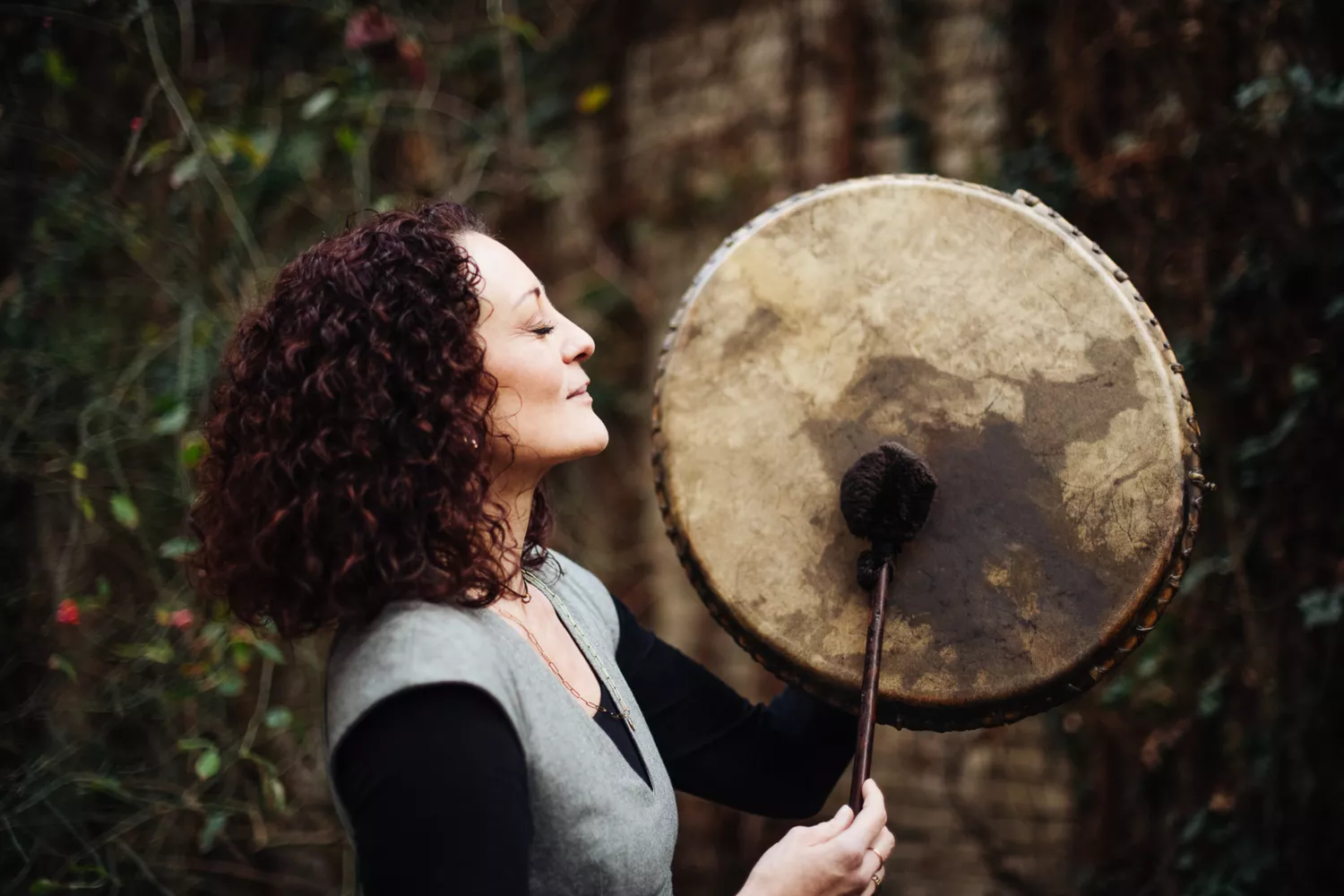
Shaman Katja Neumann
Shamanism and Psychedelics
What is the significance of psychedelics and plant medicine in shamanism, and what is your personal stance on them? Have you worked with them before?
It is a very important component that I consider very valuable and sacred. It is a gift from the gods to us, which supports us in our courage to incarnate in three dimensions. It helps us to lean into multidimensionality again. I have participated in about 70 Ayahuasca ceremonies and like to call that my second shamanic training. I have also been fortunate enough to experience San Pedro, Iboga, Peyote, and Kambo. I use Rapé, the shamanic snuff, among other things for cleansing foreign energies, every evening.
What was one of the most profound or transformative experiences you had with psychedelics?
Due to the many Ayahuasca and San Pedro ceremonies, there have been several special experiences. For example, I was able to integrate my childhood abuse in a completely different way; I spoke with my angel; I was allowed to see my soul, to immerse myself in all-love; I was allowed to ask many questions – e.g., about death, transitions, parallel universes. But perhaps the most impressive thing was that it showed me, above all, that my intuition is "right" and that I am "right." The idea that my trance journeys "only" with a drum were less valuable was a fear I had at one point.
What is your opinion on the growing popularity of psychedelic substances in the Western world?
I generally view it positively. Our Western conditioning means that far more harmful substances like industrial sugar, alcohol, and cigarettes are completely normal, while this medicine – and these substances are medicine! – falls under the Narcotics Act. That's somewhat absurd. Years of talk therapy helped me less than individual Ayahuasca ceremonies.
Are there aspects that you view critically?
I view it critically that here, too, the quick money is often the driving force; that people who have little knowledge also offer it, and that it's difficult for a layman to recognize this. I have seen people really freak out at ceremonies, and then those who were leading them were completely overwhelmed at times. That's not acceptable. A safe, sacred space must always be created.
Conversely, however, challenges can arise when ceremonies are led by South American indigenous people: they are completely unfamiliar with our Western illnesses and therefore cannot manage them. An indigenous person doesn't know what burnout or eating disorders are, and has never heard of ADHD – how are they supposed to deal with that?
What recommendations and advice would you give to people who want to embark on their first psychedelic experience?
It should call to them. Many who do it out of a hype, because everyone else is doing it, are often not ready yet – or have so much fear that they cannot surrender to it. I believe it is not automatically suitable for all people. Prior experience in meditation or other spiritual practices can be helpful to be able to engage with it.
Are there specific rituals or preparations that you find particularly helpful?
For Ayahuasca and San Pedro, for example, a diet beforehand is necessary. This includes: no alcohol, coffee, salt, meat, spicy foods, industrial products, perfumes... at least three, preferably five days before the ceremony. On the last day, nothing should be eaten after noon at the latest. Otherwise, the probability is very high that one will vomit severely.
However, it's not just about cleansing the body, but also about "starving" the ego, becoming permeable and humble. Plants vibrate at a much more subtle frequency than we do. Everything has a vibration, a frequency – and we humans vibrate much more heavily and are more gross-material than plants. By abstaining from certain foods, we become thinner-skinned, more sensitive, and the spirit of the plant can reach us much more easily. We have to approach them – not the other way around.
Being aware of one's intention – what one wants or wants to let go of – I can also highly recommend.
Integration is another important point. How can these experiences be sustainably incorporated into everyday life?
What is needed, in my opinion, is a conversation in the days afterward, e.g., with a therapist, to process what has been brought to the surface. This leads to a better understanding, anchoring, and old patterns can also be reconditioned. Because it is no more a miracle cure than anything else.
For example, I have had a naturopath for 20 years whom I see regularly. She does a mix of conversation, craniosacral therapy, and chakra cleansing. That has helped me a lot. A friend with whom I often attended ceremonies did not do that, and in my opinion, he is still stuck in his old patterns – despite many Ayahuasca ceremonies. "Change" can only ever come from within ourselves; no one does it for us – no medicine, no vision journey.
A Look into the Future
What is your vision for the future of psychedelic and shamanic healing arts in the Western world?
It will become a completely normal part of our healing practices – at least on par with conventional medicine.
What would you recommend to someone who wants to explore the path of shamanism – both in search of support and for those who want to learn this path themselves?
I would always recommend seeking someone who can accompany you, hold the protected, sacred space, or groups where you can exchange ideas. In doing so, I would personally also make sure that not too many healing methods are mixed together – that is unfortunately a trend in our Western world.
Books I recommend I have already mentioned. I can also recommend Michael Harner's The Way of the Shaman. I greatly appreciate Alberto Villoldo, and I also like the free courses offered by platforms like Younity & Co. But that has nothing to do with training and practical experience.
What fulfills you most in your work when you look at the people who have found their way with your support?
It fulfills me greatly when what has always been present in people is brought to life and remembered. Our Western world often distances us from our inner nature through performance demands and norms. As a result, many people are no longer the masters of their own lives, but only reacting and functioning – and they no longer feel themselves or their inner calling.
When this self-awareness re-emerges and they blossom like a flower, it's simply wonderful. There is no greater compliment than to hear that they feel truly seen by me. Because not being seen or understood, and being empathetically pigeonholed or diagnosed, is something I always suffered greatly from – even in my initial search for myself and in the therapies I underwent.
Is there anything we haven't touched upon that is particularly important to you?
A film comes to mind that I think is great: Crazywise by Phil Borges. It shows how Western societies and indigenous peoples deal with "mental illnesses" differently. In doing so, it highlights both the influence of the pharmaceutical lobby and the contrast between exclusion and the loving "taking into the center" among indigenous peoples.
Biography
 4)
4)
 4)
4)
 4)
4)
 4)
4)