
Artsy Shot: Question everything
A contribution by Kate
Executive Summary
Timothy Leary was a psychologist, LSD visionary, and one of the most captivating figures of the 1960s psychedelic movement. As a charismatic thought leader, his radical ideas, provocative experiments, and his mantra "Turn on, tune in, drop out" influenced an entire generation. This article illuminates his life journey, his legacy for today's psychedelics research – and why his message is more relevant than ever. A deep dive into consciousness, rebellion, and cultural transformation.
Timothy Leary is one of the most dazzling figures in psychedelic history. He shaped the psychedelic movement like no other: through visionary experiments with LSD, radical taboos broken, and a revolutionary view of consciousness and society. His name is inextricably linked with psychedelic culture. In this article, we delve deep into the life and work of LSD icon Timothy Leary and explore how his legacy shapes our current view of psychedelics.
☝🏻 Disclaimer: Please be sure to observe our risk notices.
Who was Timothy Leary really?
Timothy Leary was born in Springfield in 1920. In the 1960s, he became a charismatic LSD ambassador who encouraged others to "expand their minds." He earned his PhD in psychology from the University of California, Berkeley. Later, he conducted research at Harvard University – a place where he soon became an internal troublemaker. Here, along with Richard Alpert (later Ram Dass), he began conducting controlled studies on the effects of psilocybin – with prisoners, students, and intellectuals as subjects.
His famous slogan "Turn on, tune in, drop out" became the mantra of the counterculture. Leary didn't mean "withdrawal," but rather conscious reorientation: Turning on for inner growth, tuning in to inner frequencies, and dropping out of blind functioning. With the created slogan, he shook the foundations of Western society. Conventional thinking was radically questioned.
His mission was clear: He wanted to open the doors of perception and explore human consciousness, all without fear of authorities, of course.
Timothy Leary and LSD: Between the urge for knowledge and rebellion
As early as the early 60s, Timothy Leary experimented with LSD (lysergic acid diethylamide). For him, it was not a drug, but a tool – a catalyst for consciousness research. He regarded LSD as a "spiritual microscope" with which the structures of one's own psyche could be observed and transformed.
A fitting quote from Timothy Leary: "LSD is a microscope for the soul" – something Kate experienced firsthand during her first time with LSD.
This attitude earned him both admiration and rejection. Leary was dismissed from Harvard, came under the scrutiny of the FBI and the Nixon administration – who later called him "the most dangerous man in America." If that wasn't a huge ego boost that then had to be shed. But to this day, his experiments in the Harvard Psilocybin Project are considered pioneering work: They laid the foundation for today's studies on psychedelic therapy.
Criticism of Leary did not only come from outside: Even companions accused him of wanting too much, too soon. His activist zeal overshadowed scientific rigor – a conflict that is still debated in the psychedelic scene today.
However, Leary always defended his work and findings by referring to the individual's self-determination. This is an idea that still shapes debates today. You can imagine what we in the club think about the state having to "protect" verbose people from themselves. And why the "loving and protective fatherly hand" then doesn't stop at cigarettes and alcohol, someone seriously needs to explain to us.

Timothy Leary's Legacy: Between Genius, Eccentricity, and Escalation
In the 1970s, Timothy Leary increasingly came into the crosshairs of US authorities. In 1970, he was sentenced to 20 years in prison for possessing small amounts of cannabis. The case was blown out of proportion by the media – Leary became a symbol of the so-called "War on Drugs." But Leary had other plans: With the help of the Weather Underground, a radical left-wing underground organization, he made a spectacular escape from prison in California.
Together with his then-partner Rosemary Woodruff Leary, he subsequently lived in exile under a false identity – first in Algeria, where they were in contact with exiled Black Panther activist Eldridge Cleaver for a time. Later, they fled further to Switzerland, Vienna, and Kabul. There, Leary was finally captured by the US Drug Enforcement Administration (DEA) and brought back to the USA.
Despite this eventful life, Leary was not a classic activist. He was an intellectual obsessed with the idea of exploring and transforming human consciousness. For him, LSD was a tool, not an escape – a means of spiritual self-discovery, which, however, quickly became politically and socially charged in widespread use. Critics accused him of naivety and overestimation, while others saw him as an uncompromising visionary.
His radical commitment to individual freedom ("freedom of consciousness") and to transcending mental possibilities was later understood by many as a precursor to today's movements around self-optimization, consciousness culture, and transpersonal psychology.
Timothy Leary: Inspiration for Art, Culture, and Music
Timothy Leary's influence on pop culture, music, and art is not just a myth – it is documented.
- John Lennon and Yoko Ono were demonstrably inspired by Leary: Their song "Come Together" was originally conceived as a campaign song for Leary's candidacy for governor of California.
- The Moody Blues dedicated the song "Legend of a Mind" to him, in which the line "Timothy Leary’s dead" became a psychedelic anthem.
- John Lennon himself publicly quoted Leary's slogan "Turn on, tune in, drop out" multiple times.
- In the electronic music scene of the 90s, his samples were used in tracks by artists such as The Shamen ("Re:Evolution") or Tool.
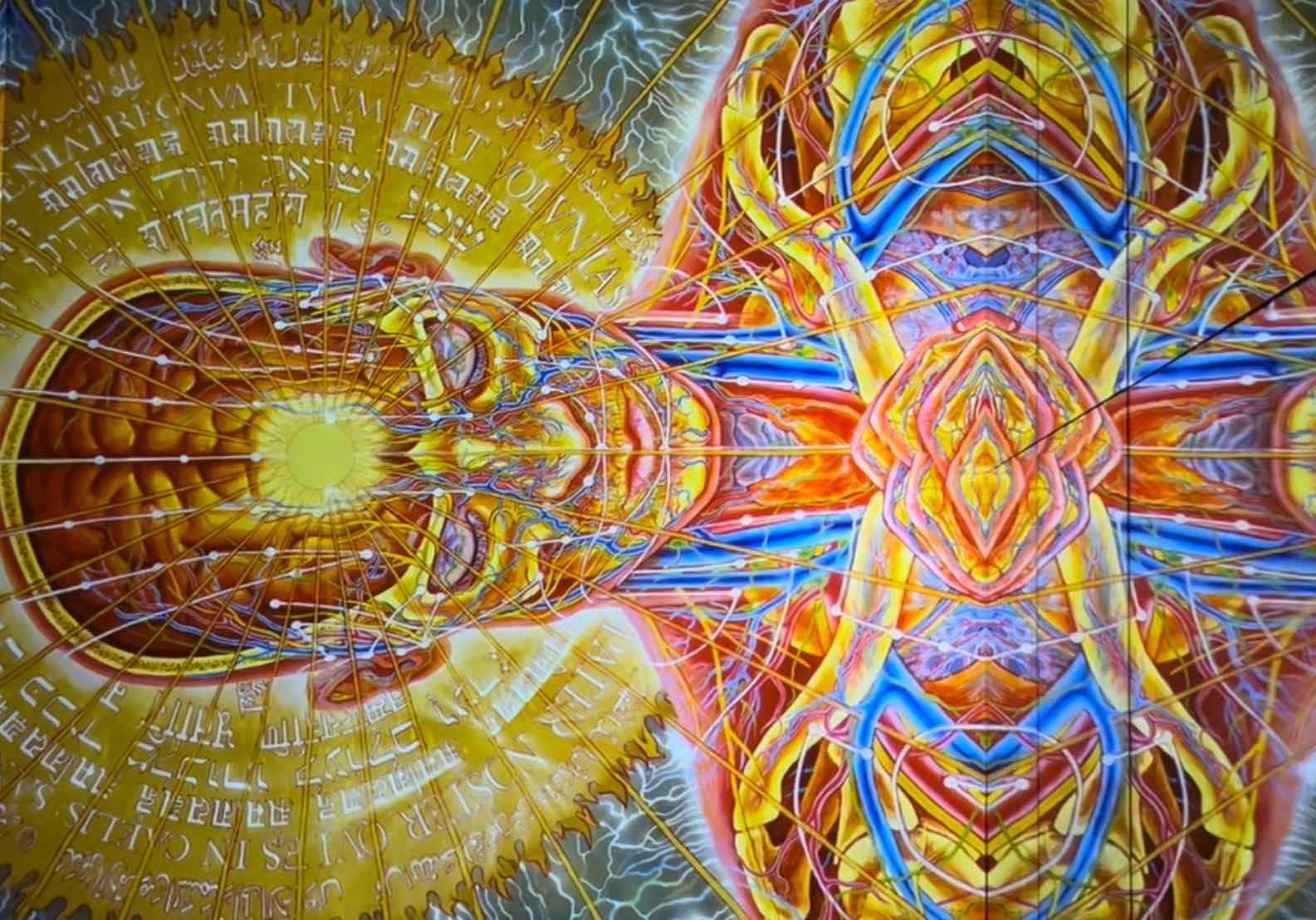
- US artists Alex and Allyson Grey, whose works play a central role in the Visionary Art movement today, cited Leary's work as an inspiration for their own creations. (See image from the Illusionaries exhibition in London, 2024)
Even today, festivals, retreats, and psychedelic educational formats dedicate exhibitions, lectures, or their own panels to him – for example, at the Psychedelic Science Congress in the USA.
Timothy Leary and the contemporary significance of LSD
Today, Timothy Leary's ideas are being rediscovered and rekindled. LSD in microdoses as well as in larger quantities is now even considered a potential therapeutic agent against mental illnesses, a creativity booster, and for promoting greater mindfulness.
Current clinical studies show that LSD has enormous therapeutic potential. It shows positive effects especially in serious issues such as treatment-resistant depression, anxiety disorders, addiction, and PTSD. Furthermore, it appears to promote creative problem-solving skills and emotional resilience, as well as enabling transpersonal insights that can complement conventional therapeutic approaches.
Much of today's research relies on the foundations Leary helped establish – particularly the understanding of set (inner state) and setting (environment) as crucial factors of effect. These concepts were popularized by him and now form the ethical foundation for all clinical (and hopefully your private) applications.
Leary's conviction that "psychedelics might not be the problem, but part of the solution," has now been established in serious scientific circles – with necessary restrictions and precautions. We'd only love to know what he thinks of Germany's fortunate situation with its LSD derivatives.
Timothy Leary as a Legend of Psychedelic Culture
Of course, Timothy Leary polarized – but his contribution to psychedelic history is undeniable. He was a thinker ahead of his time, but also shattered by it. His courage, his breaking out (in both senses), his passion: All of this shaped psychedelic culture. "Think for yourself and question authority." – a sentence that sums up Leary's legacy and hopefully will accompany you on your further journey through life.
🙏🏻 Feedback: Did you like this post or did it help you? Do you have praise, criticism, or any other feedback? Then we would immensely appreciate an email to mail@psychedelika.club or a review on Google.
Timothy Leary FAQ
What is Timothy Leary famous for?
Timothy Leary is famous for his groundbreaking LSD experiments. He is also considered a pioneer of the psychedelic movement in the 1960s. His slogan "Turn on, tune in, drop out" became synonymous with a counterculture that sought to explore human consciousness.
What actually happened to Timothy Leary?
After several prison stays, Leary temporarily fled abroad. He was arrested several times for his work. In 1976, however, he was finally released. He died of prostate cancer in 1996. His ashes were later scattered in space.
What did Timothy Leary say?
Leary is known for many quotes that shaped the psychedelic scene, including: "Turn on, tune in, drop out" or "LSD is a microscope for the soul." His words reflect the spirit of a time when people were willing to explore their mental limits.
What role did Timothy Leary play in the hippie movement?
Timothy Leary became a veritable symbolic figure in the hippie movement. He inspired many young people to question conventional thinking and to use LSD as a path to a new level of consciousness. His speeches and actions fostered the collective pursuit of personal freedom and self-discovery.
Are there any Timothy Leary quotes that still influence us today?
Many of Timothy Leary's quotes are still cited today. Statements such as "Think for yourself and question authority" or "The universe is an intelligence test" are often found in articles and discussions about the meaning of psychedelics, freedom, and our human consciousness.
 4)
4)
 4)
4)
 4)
4)
 4)
4)